Mass Casualty Incident Training: A Complete Guide
What mass casualty incident (MCI) training is, why hospitals and medical schools run it, the drill types, and how to measure whether a drill actually worked.
A mass casualty incident (MCI) is any event where the number of casualties outpaces the resources normally available to treat them. Mass casualty incident training is how a hospital, an EMS agency, or a medical school rehearses that gap before it is real — the triage, the sequencing, and the resource calls that decide outcomes when intake doubles or triples in an hour.
This guide covers what MCI training is, why organizations run it, the drill formats to choose from, and — the part most programs get wrong — how to tell whether a drill actually improved anything.
What counts as an MCI
A mass casualty incident is a mismatch between demand and available resources — not a fixed patient count. There is no universal casualty-number threshold for declaring one. Hospitals and EMS systems set their own activation criteria based on role, capacity, staffing, and resources on hand, and that threshold moves with the time of day, current occupancy, and how fast casualties arrive.
Ten critical patients is a routine Tuesday for a large trauma center and a full-scale emergency for a rural 12-bed department. What all MCIs share:
- Demand exceeds supply for at least one critical resource — trauma bays, CT, OR time, blood, ICU beds, or trained staff.
- Standard operations do not scale. The department has to switch to a different operating mode, usually under an incident command structure.
- Triage becomes continuous, not a one-time sort at the door.
Because the definition is relative, training has to be built around your department’s real limits and your own activation criteria, not a generic template.
Why hospitals and schools run MCI training
Regulatory requirement. In the United States, the CMS Emergency Preparedness Rule requires participating hospitals to run two preparedness exercises a year, at least one of them a full-scale, community-based exercise. The Joint Commission Emergency Management standards require the same cadence and expect an evaluated response with documented improvement. Exercises are commonly designed against the FEMA Homeland Security Exercise and Evaluation Program (HSEEP) framework.
It is the only way to test the plan. An emergency operations plan is a document until a drill puts load on it. Drills surface the failures that only appear under pressure: the call tree with a wrong number, the surge space that is locked on weekends, the assumption that CT can clear 12 patients in two hours.
Medical education. For many students, the emergency department is their first real clinical environment, and there is no classroom substitute for the pressure of casualties arriving at the door. Schools run mass casualty simulations with a full cohort to teach triage algorithms and incident command, and to let students test themselves before the stakes are real.
What MCI training needs to cover for an ED physician
For an emergency physician, MCI training isn’t about treating one casualty at a time — it’s about running the whole department once patient demand outpaces normal capacity. A hospital-based exercise should force decisions across the full response, not just triage:
- Recognize and activate — decide whether the situation meets your hospital’s MCI criteria, activate the right response level, and reorganize the department accordingly.
- Create capacity — review patients already in the ED before the incident and decide who can be discharged, admitted, transferred, or moved, to free up space for incoming casualties.
- Triage incoming casualties — re-triage on arrival regardless of the category assigned at the scene, and route each patient to the right area of the department.
- Prioritize limited resources — decide who gets immediate access to resuscitation bays, CT, the OR, ICU beds, or staff when several patients need the same thing at once.
- Manage patient flow — move patients from triage through treatment, imaging, and disposition without bottlenecks, and get each one to the right area at the right time.
- Adapt as the situation evolves — respond to new casualties, changing conditions, and shifting resource limits until the department returns to normal operations.
The goal is to train physicians to see the ED as a dynamic system, not a series of individual patients — decisions about capacity, priority, and flow matter as much as the clinical call.
Drill types
Exercises run on a spectrum from discussion-based to operations-based. Each format trades realism for cost and complexity.
| Type | What happens | Best for | Cost / effort |
|---|---|---|---|
| Tabletop | Key staff talk through a scenario around a table, guided by injects. No physical movement. | Testing decision-making, roles, and plan knowledge. Onboarding new leaders. | Low |
| Interactive digital simulation | An individual physician manages virtual patients through an MCI scenario, deciding triage, treatment, and disposition. | Repeated practice in prioritization, resource allocation, and patient flow — on their own schedule. | Low |
| Functional exercise | One or more functions (e.g. the command center, or triage) operate in real time against simulated inputs. Patients are simulated, not physically moved. | Testing coordination and communication under time pressure without full mobilization. | Medium |
| Full-scale exercise | Real deployment: simulated patients with moulage, actual triage and treatment areas, EMS, and often community partners. | Testing the whole system end to end, including physical flow and resource bottlenecks. | High |
Most programs over-invest in the annual full-scale exercise and under-invest in frequent, cheap repetition. A tabletop every quarter builds more durable skill than one large drill a year that no one repeats — and a digital simulation goes further, since one physician can run it alone, any time, without scheduling a room or a facilitator.
A digital simulation isn’t a substitute for team exercises. It won’t reproduce live coordination with other departments, EMS, or outside agencies — that still needs a functional or full-scale drill. What it does well is the part those drills can’t repeat often enough: the individual clinical decisions — triage, resource calls, disposition — that a physician needs to make fast and correctly when the department is overwhelmed.
MCI levels
There is no national or international standard for grading MCI scale — schemes are set locally, by a hospital system or regional plan, so the response can be sized to the event. One example of a tiered structure:
- Level 1 — casualties can be absorbed by the receiving facility with internal surge measures.
- Level 2 — the event exceeds one facility; regional mutual aid and patient distribution are needed.
- Level 3 — a regional or state response, with casualties distributed across many facilities and external resource requests.
Don’t train against this example. Train against the activation levels your regional plan or hospital system actually defines — the names, thresholds, and number of tiers all vary by jurisdiction.
The MCI drill cycle
A drill is only worth running if it feeds back into the plan. The cycle:
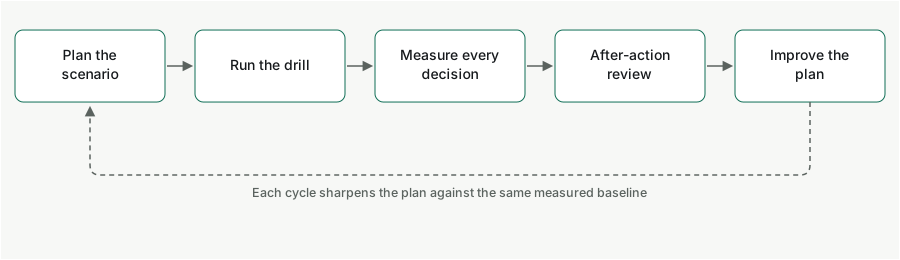
The two steps programs skip are measure and improve. Without a measurement plan written before the drill, the after-action review collapses into impressions. Without re-running the scenario after fixing the plan, there is no evidence the fix worked.
How to measure whether a drill worked
Decide the metrics before the drill, not after. Useful ones:
- Time to activation — from first casualty notification to a declared MCI and an activated plan.
- Time to first triage complete — how long until every arrived casualty has a triage category.
- Triage accuracy — over-triage and under-triage rates against an expected-outcome key. Over-triage wastes scarce resources; under-triage costs lives.
- Resource use against physical limits — did the recorded activity stay within what the department can physically do? If the report shows 14 patients through one CT scanner in two hours, the tracking failed.
- Decision log — who decided what, and when. This is where debriefs find the froze-or-sequenced-wrong moments.
Manual tracking — an observer with a stopwatch following each player — is where most of this data is lost or invented. A drill that records every state change and decision automatically produces an after-action report that reflects what actually happened, and lets the same scenario be replayed for the debrief.
Common failure modes
- No repeat. A scenario run once, never again, teaches a story rather than a skill.
- Unmeasured. No pre-defined metrics means no way to compare this year to last.
- Generic scenario. A drill that ignores your real bed count, scanner throughput, and shift staffing rehearses someone else’s department.
- Impossible reports. Numbers that exceed physical capacity mean the tracking method can’t tell success from wishful thinking.
- No corrective actions with owners. Findings without a name and a due date do not change the plan.
Reference
Download the MCI drill planning checklist (.txt) — a one-page list covering scope, roles, the measurement plan, logistics, and after-action steps.
Where this guide goes next
Deeper spokes under this pillar will cover:
- How to run an MCI drill, step by step
- MCI triage in the field
- MCI levels (1 / 2 / 3) explained
- Tabletop vs. full-scale exercises
- Writing an after-action report for an MCI drill
- MCI drill scenario examples
For the triage algorithms themselves, see the disaster triage systems guide. For the command structure a drill runs under, see Incident Command System.
Rehearse it in Youfers
Youfers runs a mass casualty incident against a model of your own department and tracks every decision for the after-action report.
Book a demo →